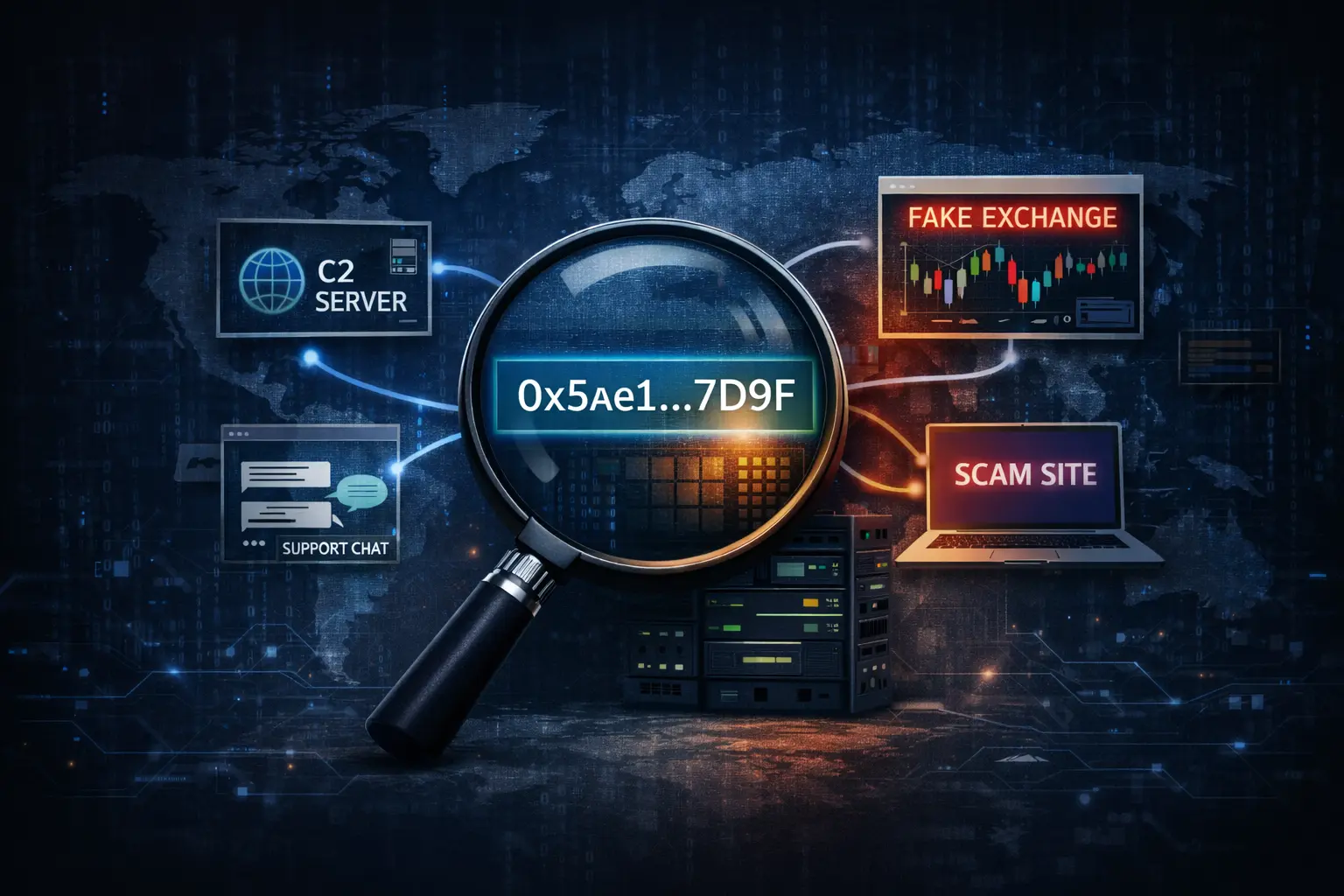
Mapping Crypto Scams Through Infrastructure OSINT
Disclaimer
All information in this article is provided strictly for educational purposes and authorized security research. The tools, techniques and workflows discussed must only be used on systems you own or have explicit permission to investigate.
Unauthorized information gathering or misuse of OSINT techniques may violate applicable laws and regulations, including but not limited to the Computer Fraud and Abuse Act (CFAA), GDPR, and the Investigatory Powers Act. Always operate within legal and ethical boundaries.
The Industrial Scale of Crypto Fraud
The era of the lone crypto scammer is effectively over.
Modern cryptocurrency fraud operates at industrial scale. Organized groups run scams like businesses, complete with customer support scripts, marketing funnels, fake mobile apps, and distributed infrastructure. Wallets are reused across campaigns. Domains rotate. Support chats are shared across dozens of fake platforms.
For OSINT investigators, this changes the game.
A wallet address is no longer just a destination for stolen funds. It is an operational artifact. It appears on phishing sites, in Telegram bots, embedded in JavaScript, pasted into YouTube descriptions, and hardcoded into fake trading dashboards.
The goal is no longer just to follow the money.
The goal is to follow where the wallet exists outside the blockchain.
Wallet-to-Infrastructure Pivoting Explained
Most beginners treat crypto investigations as purely on-chain.
They trace transactions from Wallet A to Wallet B until the trail ends at a mixer, bridge, or exchange. At that point, attribution usually stops.
Wallet-to-infrastructure pivoting flips the question. Instead of asking where the money went, we ask where the address appeared.
Scammers cannot convince victims to send funds to a random hexadecimal string without context. That context lives on the web. Websites, support emails, Telegram bots, Discord servers and fake apps all need to present the wallet somewhere.
By identifying where a wallet is published, we can pivot into:
- Scam domains
- Hosting providers
- Support infrastructure
- Related campaigns operated by the same group
This is where general OSINT becomes more powerful than on-chain analysis.
Why This Matters in Investment Frauds
Investment fraud remains the largest source of crypto-related losses globally. Pig butchering scams rely on long-term grooming, fake trading platforms, and social engineering rather than technical exploits.
In these cases:
- The scammer’s identity is fabricated
- The application is sideloaded or privately distributed
- The exchange itself does not exist
The wallet address is often the only real artifact the victim has.
If you can link that wallet to a domain or hosting provider, you unlock attribution paths that include registrar records, infrastructure reuse, and cross-campaign correlation.
This is where infrastructure pivoting becomes critical.
Manual OSINT Techniques
Before relying on automation, it is important to understand the manual foundations.
1. Block Explorer Analysis
Start with the native block explorer for the chain involved.
Key things to review:
- Comments or notes posted by victims
- Transaction frequency and patterns
- Sweeping behavior into exchange hot wallets
- Reuse across multiple victim addresses
Victim comments are often the first public signal that an address is malicious.
2. Google Dorking Wallet Addresses
Wallets frequently appear in public places. Use exact-match searches and exclude block explorers to reduce noise.
Example:
"0x1234567890abcdef1234567890abcdef12345678" -site:etherscan.io
To narrow context, add scam-related keywords:
"0x12345678" AND ("giveaway" OR "support" OR "double your")
This often reveals fake support pages, cloned exchanges, and social media scams.
3. Scam Reporting Databases
Manual confirmation can be done through:
- Chainabuse
- BitcoinAbuse
- Community scam registries
These are useful but fragmented and time-consuming to check individually.
Automating the Infrastructure Pivot
Manual wallet analysis does not scale well. As investigations move beyond single incidents into coordinated fraud campaigns, structured intelligence platforms become necessary to manage volume and correlation.
Modern OSINT tooling can consolidate wallet intelligence into a single workflow that pivots from blockchain artifacts to associated web infrastructure. Rather than viewing a wallet in isolation, these systems treat it as an entry point into a broader operational footprint.
Step 1: Address Lookup
At the initial stage, wallet analysis typically involves cross-checking the address against multiple public and community-driven reporting sources.
You get:
- Scam category labels
- Prior reports
- Context around known abuse patterns
This is your triage step.
Step 2: Websites by Address
This is the core pivot.
Sites like UserSearch maintains an index of websites that display specific wallet addresses. This allows you to reverse-map a wallet to domains using it.
If a wallet appears on a domain, you now have:
- A registrable asset
- Hosting infrastructure
- A starting point for attribution
This is where most investigations break open.
Step 3: Domain Forensics
Once a domain is identified, further infrastructure analysis can reveal patterns that extend beyond a single site.
Key pivots include:
- Historical WHOIS and registrar data
- Hosting changes and infrastructure reuse
- Archived versions of scam sites
- Shared third-party identifiers such as analytics or chat widgets
These signals allow individual scam sites to be clustered into larger campaigns and, in many cases, attributed to the same underlying operation.
Legal and Ethical Considerations
Crypto scam investigations often involve hostile or malicious infrastructure. Operational security should be treated as a core requirement, not an afterthought.
When conducting OSINT work:
- Avoid visiting scam domains from a personal or identifiable browser
- Use virtual machines, network isolation and hardened environments
- Favor passive intelligence collection over direct interaction
- Do not attempt to exploit, disrupt, or interfere with scam infrastructure
Investigation should remain focused on observation, correlation, and responsible reporting through appropriate channels.
Closing Thoughts
On-chain tracing alone is increasingly insufficient for modern crypto fraud investigations.
Effective attribution emerges when blockchain data is combined with web and infrastructure intelligence. Wallet addresses are not merely financial endpoints. They function as operational fingerprints that surface across domains, hosting providers, and coordinated scam campaigns.
When approached this way, even highly anonymized operations begin to expose patterns.
At scale, this type of analysis requires tooling that supports wallet-to-infrastructure pivots and structured correlation across data sources.