How to Investigate a Username Across the Internet
Understanding how usernames reveal digital footprints is one of the most useful skills in OSINT and cybersecurity. Most people reuse usernames across platforms, which creates identifiable patterns. This blog explains how analysts investigate a username on the internet using structured workflows and DeepFind.me tools.
Why Usernames Matter in OSINT
A username is often the first and most accessible data point in an investigation. Unlike emails or phone numbers, usernames are typically public and used on multiple services. This allows analysts to uncover:
- Active and abandoned accounts
- Interests and behavioral patterns
- Breach or infostealer exposure
- Possible identity links
- Online communities and affiliations
In cybersecurity investigations, usernames help map the surface area of a target, understand risks, and discover exposed assets.
Starting Point Example: The Username "ShadowWolf92"
Consider a fictional username that appears in a Discord chat during a reported incident. The only information available is the handle: ShadowWolf92. OSINT begins with minimal data, and the goal is to build a complete picture from public information.
The next steps show how an analyst would process this username.
Step 1. Finding All Accounts Using the Username
The first step is to locate every platform where the username exists. Manual checks are inefficient because they require searching dozens or hundreds of websites.
DeepFind.me provides a Username Search tool that automates this process across social networks, forums, gaming sites, and developer platforms.
A simplified representation of this process looks like:
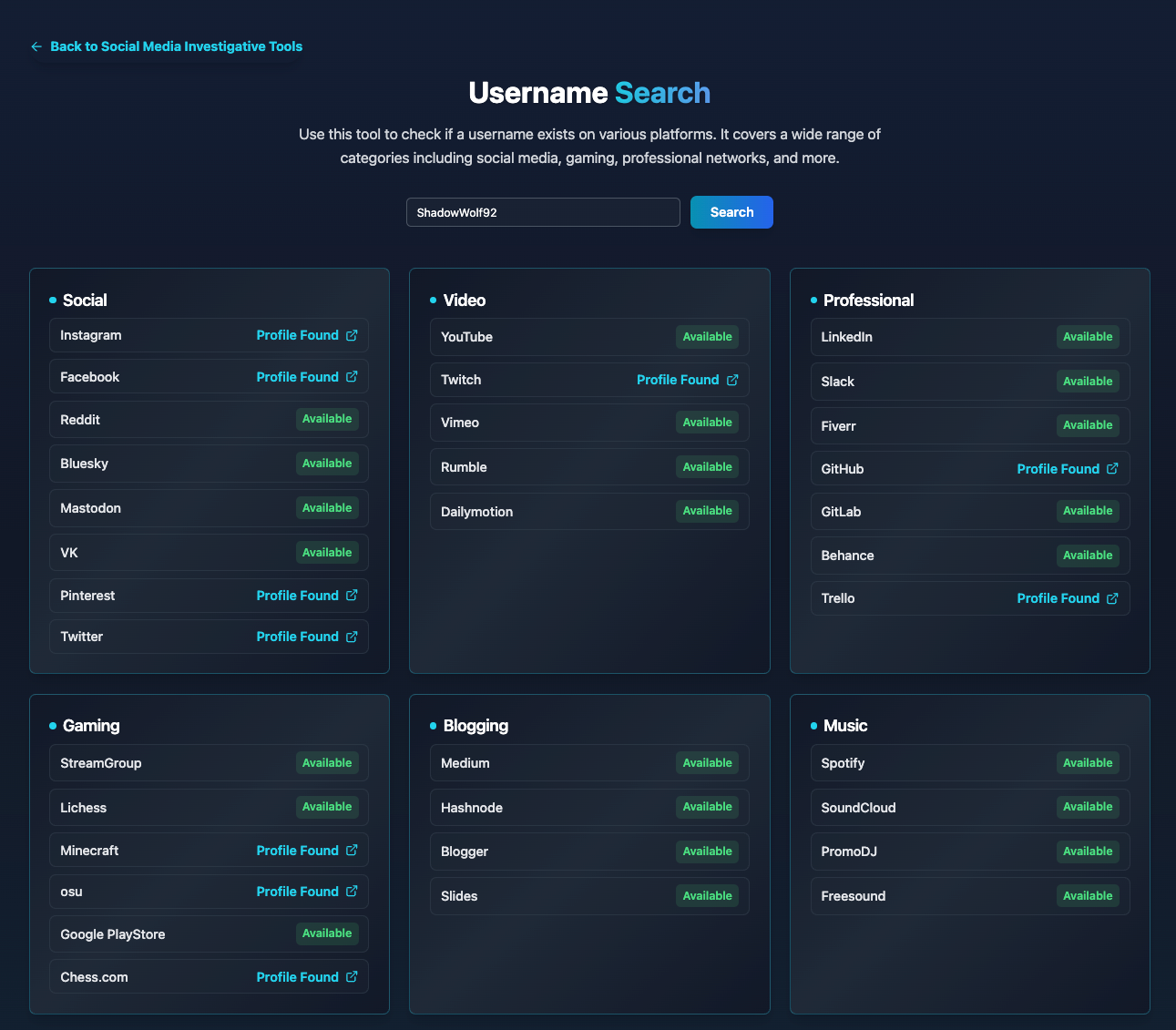
In practice, the tool performs hundreds of checks and returns a consolidated list.
Common patterns to observe include:
- Reused avatars
- Similar biography text
- Consistent external links
- Timezone hints from posting patterns
Suppose the search finds the username on Reddit, GitHub, Steam, and Instagram. These form starting points for further analysis.
Step 2. Checking Exposure in Infostealer Logs
Before analyzing behavior, it is important to check whether the username appears in infostealer logs. Infostealers are malware programs that extract information from infected devices such as saved passwords, cookies, browsing data, and autofill fields.
Even if passwords are not visible, usernames in logs indicate potential device compromise.
DeepFind.me offers a Username Infostealer Lookup tool that allows users to safely check whether their alias appears in such breaches.
If "ShadowWolf92" is present in logs, this suggests a past infection on the user's device. This also helps analysts evaluate risk levels and understand whether associated accounts may have been accessed by unauthorized parties.
Step 3. Connecting Accounts Using Correlation Techniques
Correlation is the stage where separate pieces of information begin forming a coherent profile. Analysts use a combination of technical and behavioral indicators.
Common correlation signals include:
- Avatar Reuse
Many individuals reuse the same profile picture across platforms. - Biography Similarities
People often repeat short self descriptions such as job titles or hobbies. - Handle Variations
Variants such as ShadowWolf, Shadow Wolf, or Wolf92 often belong to the same person. - Geolocation Hints
Even a single tagged post can provide regional clues. - Posting Time Patterns
Regular activity times frequently indicate timezone. - Writing Style Consistency
Sentence structure, vocabulary choices, and punctuation habits can be strong identity markers.
This phase is often the most insightful part of the investigation, since it converts raw findings into meaningful intelligence.
Step 4. Verification and Ethical Considerations
Verification ensures that assumptions are not mistaken for conclusions. OSINT must be supported by multiple independent signals. Analysts avoid drawing conclusions from a single source or isolated observation.
Important practices include:
- Checking consistency across platforms
- Comparing metadata when possible
- Validating correlations through repeat evidence
- Avoiding identification beyond what is publicly accessible
- Respecting privacy and ethical guidelines
DeepFind.me is designed around responsible OSINT practices that focus on awareness and security rather than personal intrusion.
A Practical OSINT Workflow for Username Intelligence
A summarized workflow for username investigations looks like this:
- Discover all linked accounts
Using DeepFind.me Username Search. - Check for breach exposure
Using DeepFind.me Username Infostealer Lookup. - Analyze digital behavior
Using DeepFind.me Profile Analyzer. - Correlate identities across platforms
Using avatar analysis, language patterns, time activity, and metadata. - Verify findings
Through cross-checks and contextual reasoning. - Document insights
With a clear summary of risks, patterns, and potential identity clues.
This sequence mirrors the workflow used by cyber analysts, red teams, and OSINT professionals.
Why Username Investigations Still Matter in 2025?
Even with growing use of AI tools, usernames remain one of the strongest identifiers in OSINT because they are:
- Publicly accessible
- Frequently reused for long periods
- Found in both open web and breach datasets
- Attached to recognizable patterns
- Easy to correlate at scale
For individuals, username OSINT highlights the importance of managing digital footprint. For professionals, it allows deeper understanding of threats, account exposure, and online behavior patterns.